

How Much Does a Law Firm Website Cost in Australia?
Lawyers dislike vague pricing as much as their clients do. Here are the honest indicative bands for a professionally built law firm website in Australia, and the factors that actually move the number.
Fady Ilias
Director, Web Divine

Lawyers spend their working lives explaining to clients why "how much will it cost?" has no one-line answer, and then get exactly the same treatment when they ask agencies about a website. Most won't publish a number at all.
We think that is a poor way to treat a professional buyer. So here is the honest version: the indicative bands, what genuinely moves the number for a law firm, and how to think about the spend, written so a principal or practice manager can walk into any agency conversation knowing what a fair answer sounds like.
Why nobody publishes prices (and why that hurts everyone)
Price opacity is, ironically, the legal industry's own documented sore point. The Productivity Commission's Access to Justice Arrangements report (2014) found the legal-services market suffers from a lack of clear price information, and recommended a public guide to typical prices for common legal services, one that was never built. A rapid evidence review for the Victorian Legal Services Board and Commissioner (2021) found consumers are confused by legal costs, and that the confusion depresses satisfaction. In the UK, the Legal Services Consumer Panel's 2023 tracker found that of consumers who shopped around, only 12% found the price on the provider's website.
Firms buying web design meet the same wall from the other side. Agencies hide pricing for the same reasons some firms do: every project is different, and nobody wants to anchor low or scare off a big fish.
Every project is different. But ranges are still possible, and we publish ours. The full breakdown is in our honest guide to what a website costs. Here is how it applies to law firms.
The indicative bands
Treat these as market orientation, not a quote. A real figure only comes from scoping your firm's situation.
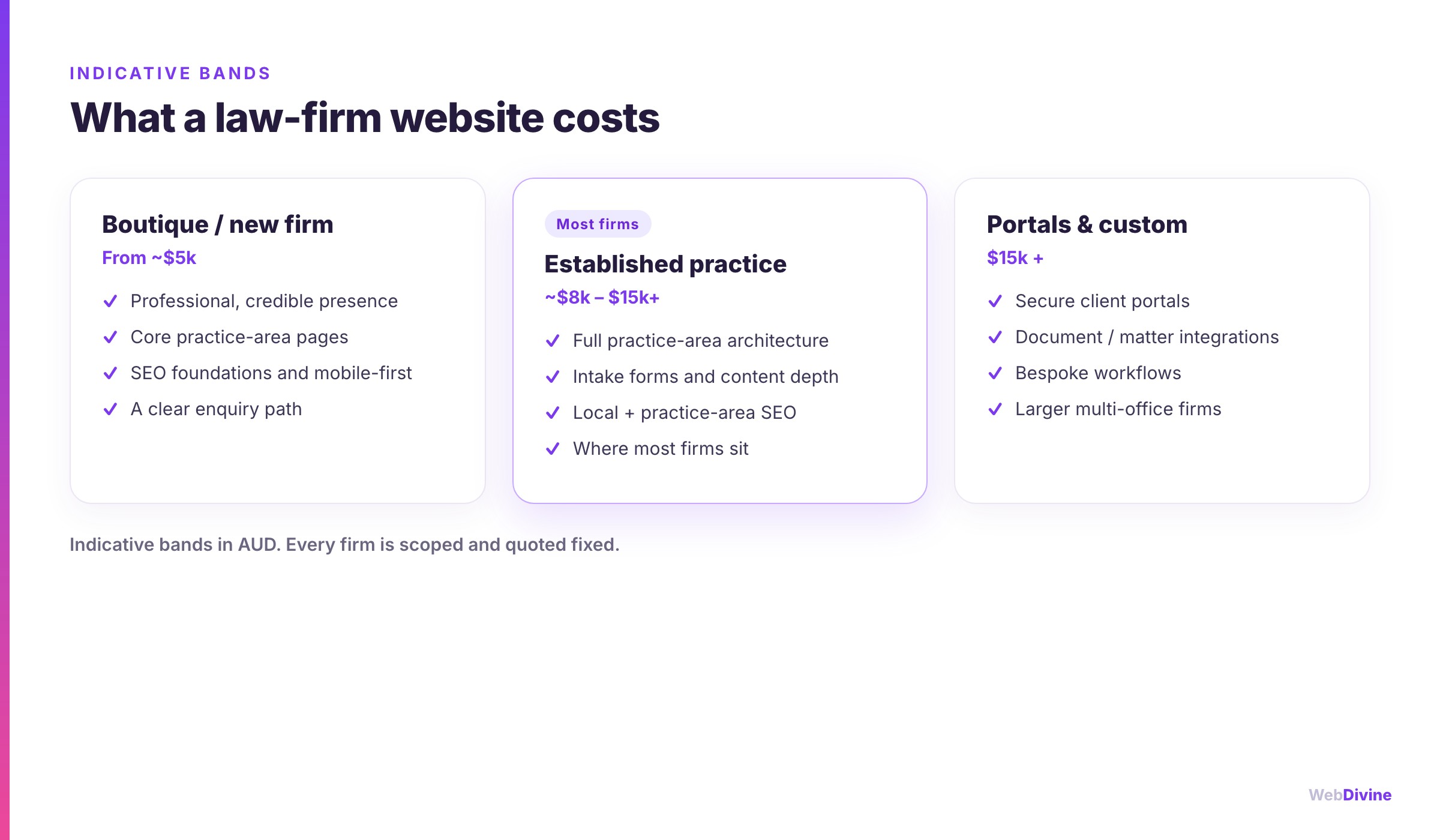
- Template and DIY builds sit below the professional bands. They exist, and for a brand-new sole practitioner they can be a rational stopgap. But a templated site cannot deliver the authority design, practice-area depth or search architecture this article assumes, and firms usually end up paying twice.
- A professionally designed and built custom site for a small business generally lands between $5,000 and $15,000. A boutique law firm site (custom design, a proper practice-area structure, professional build, search foundations) typically sits within this band. Where you land inside it depends almost entirely on the drivers below.
- Above that band sits the portal-and-integration territory. Client portals, secure intake workflows, integrations with practice-management systems, multi-office architecture or large content programmes push a project past the small-business range, sensibly, because at that point you are commissioning software, not pages.
If a proposal comes in dramatically under these bands, the missing money is usually your copy, your rankings or your ownership of the finished product. We have written before about where cheap builds actually end up costing more.
What moves the number for a law firm specifically
Law firm sites have cost drivers that generic estimates miss. When we scope for firms as part of our legal industry work, these are the levers that matter.
1. Practice-area architecture
The biggest single variable. A firm with four practice areas needs four properly written, properly designed pages; a full-service firm might need fifteen, plus sub-pages for significant matter types. Each one done well is genuine work: research, writing in the client's language, design, internal linking. Done cheaply, they collapse back into the one "Our Services" page that wins nothing. Page count driven by practice areas is where legal quotes most legitimately diverge.
2. Who writes the content
Copy is the silent budget item. Either your lawyers write it (billable hours doing something they are not trained for, on a timeline that always slips) or professional writers draft it for partner review. The second path costs more on the invoice and dramatically less in reality. Ask any agency who writes the copy and who signs it off; the answer reshapes both the price and the delivery date.
3. Intake forms, triage and portals
There is a wide spectrum between a contact form and a client portal:
- A well-designed enquiry form with sensible routing sits at the simple end.
- Matter-type triage (directing family enquiries, commercial enquiries and urgent matters to different people with different questions) adds design and build time.
- Secure document upload, client portals and integration with practice-management software are the step-change: genuinely valuable for the right firm, and priced like the software projects they are.
Scope this deliberately. Plenty of firms need excellent intake, not a portal.
4. Compliance review cycles
Legal copy gets reviewed the way legal work gets reviewed: carefully, by partners, sometimes with professional-conduct rules in mind. We cover the substance in the advertising rules to know before a redesign. Review rounds are proper diligence, but each cycle is real project time. An agency that has worked with firms builds these cycles into the plan and the price; one that hasn't will either eat the delay badly or bill you for change requests.
5. Migration and protecting what you rank for
If your current site already brings in enquiries, part of the project is making sure the rebuild doesn't destroy that: redirect mapping, preserved page equity, post-launch monitoring. It is invisible work, right up until it is skipped, and years of search visibility vanish over a weekend.
6. Photography and brand
Real photography of your people and offices does more for a legal site than any design flourish. If the firm's brand needs work before the site can carry it, that surfaces here too. Either allow for it or acknowledge the compromise.
The ongoing costs nobody itemises
A website is not a one-off purchase. Budget honestly for:
- Hosting and maintenance: modest, but real, and the thing keeping the site fast and secure.
- Content over time: articles and updated practice pages are how a legal site compounds in search rather than decaying.
- Search engine optimisation: if visibility matters to the firm's growth, real SEO is a sustained engagement, not a launch-week checkbox.
An agency that pretends there are no ongoing costs is not being kind. It is deferring the conversation.
How to think about the spend
The useful frame is not "what does a website cost?" but "what is the site expected to return, over how long?" A well-built site works for five or more years. Across that life, even a modest flow of additional instructions, matters that would otherwise have gone to the other name the client was given, makes the build cost look small next to what a single practice area bills in a quiet month. Cost it as infrastructure amortised over its life, not as this quarter's marketing spend.
Fair market orientation: template builds below the professional bands, most boutique firm sites within the $5,000–$15,000 custom range, portals and integrations above it. The honest variable is scope, and an agency should be able to explain every dollar of yours.
Keep reading: before you spend anything, make sure you know what makes a great law firm website, and which advertising rules should shape the copy before it is written.
We scope every project individually, with senior people on every engagement and no junior hand-offs. See our law firm work, or the results for Reclaim Legal. For a real figure attached to your firm's actual situation, talk to us. We'll tell you honestly if the answer is that you don't need a rebuild yet.
Written by
Fady Ilias
Director, Web Divine
Fady Ilias is the director of Web Divine, a senior-led web design and development studio in Melbourne. He works hands-on with Australian businesses on conversion-focused websites, Shopify stores and custom web apps - senior people on every project, no junior hand-offs.
More about Web DivineKeep reading
More insights

How Much Does a Shopify Store Cost in Australia?
There's no single price for a Shopify store, but there are honest bands. Here's what drives the number up or down, and the ongoing costs most owners forget to budget for.

Why we scope before we quote
You get a fixed price for your website, just not before we understand the job. Here's why we scope first, and what the fixed price covers once we do.

What Makes a Great Law Firm Website? (Australia 2026)
Most law firm websites look fine and do nothing. Here is what actually separates a site that wins instructions from an expensive brochure - and the questions that reveal whether an agency can build one.






















Let's talk about your project
Book a call with the people who would actually build it. You'll get straight answers on scope and timeline, and a fixed quote once the project is scoped.