

Law Firm Advertising Rules & Your Website (Australia)
Your marketing is regulated in ways most web agencies have never heard of. An awareness-level tour of the rules that should shape every claim, testimonial and title on a law firm website.
Fady Ilias
Director, Web Divine

Every law firm website is advertising, and legal advertising is regulated, which makes a redesign one of the few marketing projects where your agency's best work can become your compliance problem.
A note before we start. You are the lawyers; we are not, and this is not legal advice. It is general web-design guidance at awareness level only. Professional-conduct rules and advertising restrictions vary by state and change over time. Verify the current position with your regulator, professional association or own advice before you publish a word. What we can offer is the other half of the picture: how these rules should shape a website project in practice.
Most web agencies have never heard of any of this. They write the way they write for retailers (superlatives, sweeping promises, manufactured urgency) and the first time anyone checks the copy against the conduct rules is after it is live. This article exists so that never happens to your firm.
The baseline: Rule 36 and the honesty standard
For solicitors in the Uniform Law states, the operative conduct rule for advertising is Rule 36 of the Australian Solicitors' Conduct Rules. At the level of principle, it requires that marketing must not be:
- false,
- misleading or deceptive (or likely to mislead or deceive),
- offensive, or
- otherwise prohibited by law,
and it must not convey a false impression of specialist expertise. Australian Consumer Law sits over the top of all of this, as it does for any business making claims in trade.
None of that is exotic. It is an honesty standard. But it is an honesty standard with professional-conduct consequences, which is precisely why website copy deserves the same care as anything else published under the firm's name.
Who regulates what: the ecosystem to know
Part of being a well-run firm online is simply knowing who is who, and expecting your agency to know it too:
- In Victoria, the legal profession operates under the Uniform Law framework, with the Victorian Legal Services Board and Commissioner (VLSB+C) as regulator and the Law Institute of Victoria (LIV) as the professional association.
- In New South Wales, the Law Society of NSW publishes practical guidance on advertising legal services; in Queensland, the Queensland Law Society plays the equivalent role.
- The Legal Services Council maintains the Uniform Rules that Uniform Law states share.
If an agency has built for law firms before, these names are not news to them. If every one of them is news, you have learned something useful about that agency.
State variations exist, and a website advertises everywhere
The rules are not uniform across the country, and personal-injury advertising is the clearest example. Queensland maintains statutory restrictions specific to advertising personal-injury services. Victoria historically had its own personal-injury advertising restrictions, and the position changed as Victoria moved into the Uniform Law framework, which is exactly why the current rules for your state need verifying rather than assuming, especially if the last time anyone checked was a redesign ago.
The practical point for a web project: your website is visible in every state at once. A firm that practises across borders, or attracts interstate enquiries, should confirm its copy holds up under the strictest regime it touches, not just the friendliest.
What this means for the actual pages
Here is where the principles land on real design and copy decisions.
| Safe to say | Handle with care |
|---|---|
| Factual descriptions of your services and practice areas | Testimonials edited into claims a client never actually made |
| Genuine credentials and qualifications you hold | "Accredited Specialist" unless you hold that accreditation |
| Results framed with a real number or a named, verifiable matter | Inflated aggregate claims you cannot substantiate |
| Plain-language explanations of how you work | Superlatives like "the best" or "Melbourne's #1 firm" |
| Real, role-attributed client reviews | Anything implying or promising a guaranteed outcome |
Testimonials and reviews
Client testimonials are not prohibited the way they are for registered health practitioners, but they are still advertising, so the honesty standard applies in full. Practically:
- Use genuine, verifiable testimonials, ideally role-attributed ("Managing Director, manufacturing client") rather than anonymous praise.
- Do not edit a review into a claim the client never made.
- Remember Google reviews exist whether you display them or not. Earning them honestly matters more than curating them cosmetically.
Results claims
"We recovered $X" and "hundreds of successful matters" style claims are where marketing enthusiasm most often outruns substantiation. The working rule we apply when drafting for firms: a claim ships with a number or a name you can stand behind, or it doesn't ship. Outcomes framed factually, with context, beat inflated aggregates, and they read as more credible to sophisticated clients anyway.
Specialist titles
"Accredited Specialist" is a protected designation under formal accreditation schemes (in Victoria, the LIV's Accredited Specialisation scheme) and it belongs only on the profiles of lawyers who actually hold it. Beyond the protected term, be deliberate about "specialist" and "expert" language generally: Rule 36's false-impression-of-specialist-expertise limb is aimed squarely at it. "Practising primarily in family law" is safe and clear; scattering "specialists" through the headlines is a decision to make consciously, not a phrase an agency copywriter should reach for by default.
Superlatives and comparisons
"Melbourne's leading firm", "the best commercial lawyers in Australia", quite apart from the rules, these sit awkwardly on a professional site because your audience reads claims sceptically for a living. Restraint is not just compliance; it is congruence with how your clients evaluate you.
The good news: restraint converts
Here is what surprises firms most: none of these constraints costs you persuasive power. The proof that works inside the rules is exactly the proof discerning clients trust:
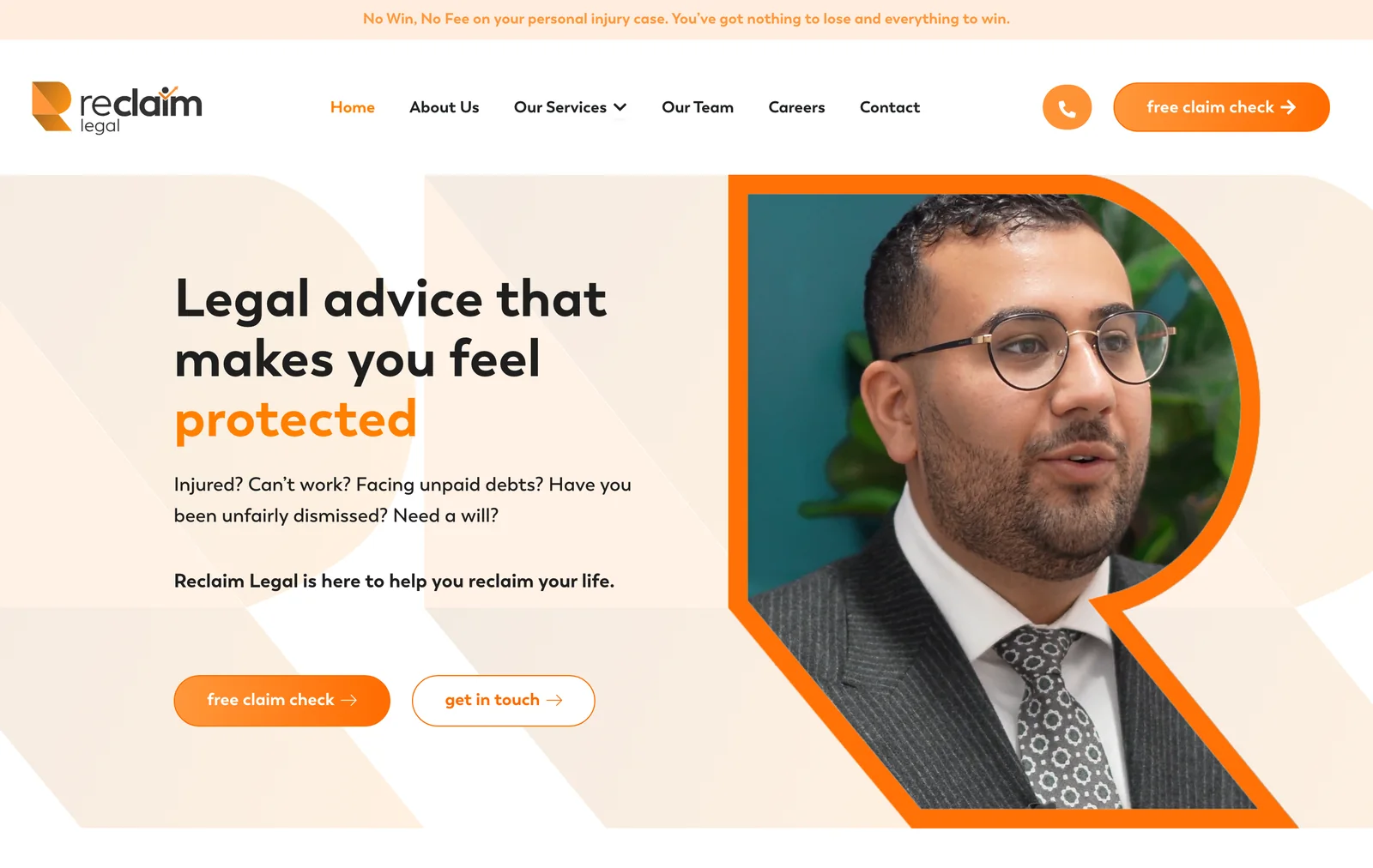
- Real, named work presented factually: the approach behind our case studies for Blackstone Commercial Lawyers and Reclaim Legal.
- Genuine credentials, genuinely held.
- Plain-language practice pages that demonstrate expertise instead of asserting it.
- Design quality that makes the authority argument no adjective can.
A site built this way needs no risky claims, because it makes its case the way a good advocate does, with evidence. That philosophy runs through everything in what makes a great law firm website.
Build the review cycle into the project
The operational takeaway for a redesign:
- Brief the constraints upfront. Tell your agency the conduct rules exist before copy is drafted, not after. Better: choose one that raises them first.
- Assign a reviewing partner early, and budget their time: copy review rounds are real project time, and they belong in the plan (and the project cost) from day one.
- Verify current rules for every state you practise in as part of pre-launch sign-off, alongside proofreading and link checks.
- Keep a record of substantiation for any results or credentials the site claims, so future updates start from evidence.
The rules ask for the same thing good marketing to professional buyers asks for: claims that are true, specific and provable. A firm that markets that way is not constrained by Rule 36. It is described by it.
Keep reading: with the guardrails clear, what makes a great law firm website covers the design and structure side, and how much a law firm website costs covers the budget.
We build websites for Australian law firms as part of our legal industry work, senior people on every project, no junior hand-offs, and copy written knowing these rules exist. If your next redesign needs a partner who won't create a compliance problem in the name of conversion, talk to us.
Written by
Fady Ilias
Director, Web Divine
Fady Ilias is the director of Web Divine, a senior-led web design and development studio in Melbourne. He works hands-on with Australian businesses on conversion-focused websites, Shopify stores and custom web apps - senior people on every project, no junior hand-offs.
More about Web DivineKeep reading
More insights

What Makes a Great Law Firm Website? (Australia 2026)
Most law firm websites look fine and do nothing. Here is what actually separates a site that wins instructions from an expensive brochure - and the questions that reveal whether an agency can build one.

Website requirements for Australian medical & allied-health practices
A practical checklist for clinic owners and practice managers - what a compliant, patient-first healthcare website actually needs, from AHPRA-aware content to accessibility and online bookings.

How Much Does a Law Firm Website Cost in Australia?
Lawyers dislike vague pricing as much as their clients do. Here are the honest indicative bands for a professionally built law firm website in Australia, and the factors that actually move the number.










Let's talk about your project
Book a call with the people who would actually build it. You'll get straight answers on scope and timeline, and a fixed quote once the project is scoped.